
How to check a Chinese supplier is real: a 5-minute background check
A slick website proves nothing. Most of a real background check takes five minutes and costs nothing. This is the one we run before a client goes near a new factory.
Richie is the British founder of Albion Exports. He has lived in China for fifteen years and does this work on the ground, in person. It comes from the factory floor, not a search engine.

A convincing website, an Alibaba Gold Supplier badge, a folder of shiny certificates. None of it proves the company you're about to wire a deposit to actually makes anything, or exists as a factory at all. The quality-inspection specialists at QualityInspection.org put it plainly: being a "gold supplier" on Alibaba doesn't mean much. It's paid placement, not verification.
Most of a real background check, though, takes about five minutes and costs nothing. This is the version we run before we let a client near a new factory, and the exact point it stops working if you're doing it from the UK.
Start with the business licence
Ask for a colour scan of the company's business licence (营业执照). Every legally registered mainland company has one, and it carries the facts you actually need:
- The 18-digit Unified Social Credit Code (USCC) at the top, the company's fingerprint across government systems.
- The company type and the legal representative (法定代表人).
- The business scope (经营范围), which is the tell. A real manufacturer's scope names production or manufacturing (生产 / 制造) of specific goods; a pure trading company's leans on wholesale and trade (批发 / 贸易).
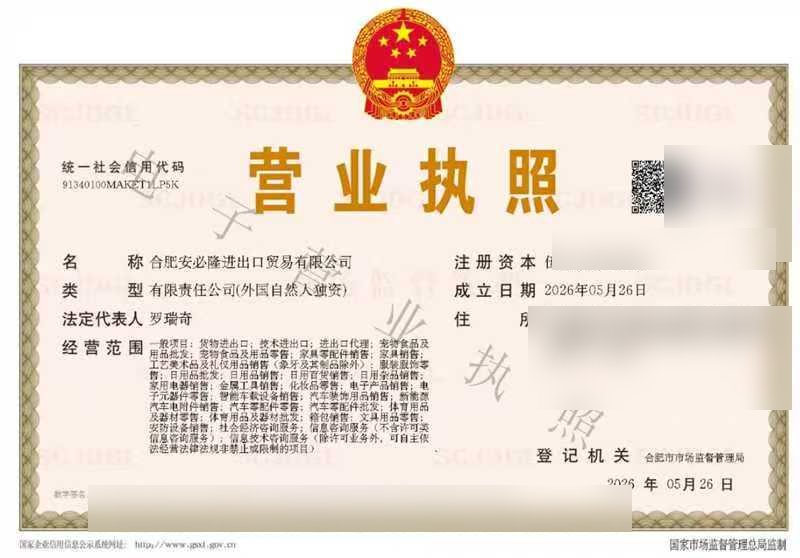
Then do the check most buyers skip. Make sure the name on the licence matches the name on the quote, the name on the invoice, and the name on the bank account you're asked to pay. That last one catches real scams: a deposit heading to a personal account, a Hong Kong account, or a company with a different name is one of the loudest warnings there is.
Check the official registry, if you can
Look the company up on China's official registry, GSXT (gsxt.gov.cn), by its exact Chinese name or USCC. Confirm the licence details match the live record, and the status reads 存续 / 在营 (active) rather than 注销 / 吊销 (cancelled or revoked).
This is where a UK buyer hits the first wall. GSXT is Chinese-only, the sign-in captcha is a Chinese slider or character puzzle, and the deeper records sit behind a Chinese ID and a face scan. The two databases Chinese agents actually use, 企查查 (Qichacha) and 天眼查 (Tianyancha), are worse for an outsider: both need a Chinese +86 phone number to register and take payment only through Alipay or WeChat Pay. From Britain, you often simply can't run the authoritative check yourself. The English report services that fill the gap start around $30 to $100 a company.
Prove they've actually shipped something
This is the step almost nobody does, and it's the strongest of the lot. A website and a badge tell you nothing about whether a "factory" has ever exported a single box. Customs shipping records do.
Search the company on ImportYeti. It's free, in English, and built from US customs bill-of-lading data. If the supplier is a genuine exporter, you'll see real shipments leaving China with their name on them, which buyers they ship to, roughly how much, and the product category by HS code. A broker dressed up as a factory, or a shell, shows nothing.
One honest limit: ImportYeti covers US sea imports only. A factory that mostly ships to the UK and Europe may have a thin US record, so an empty result is not proof of a scam. A full, multi-year record, on the other hand, is strong proof they're real. For UK-lane confirmation you'd need a paid global tool.
The red flags that catch the rest
Most of the remaining tells are behaviour, not paperwork. Dig harder, or walk away, when you see:
- A price 15–20% under everyone else with no explanation. As J.P. Morgan's own vendor-fraud guidance says, if an offer looks too good to be true, it usually is.
- A free email address (@gmail, @163) instead of a company domain.
- Specs that quietly change between the quote and the order.
- A refusal to let you visit unannounced, or to introduce the real factory rather than a sales office.
- A "factory" whose catalogue somehow covers everything from cookware to electronics.
The law firm Harris Sliwoski, which tracks China factory scams, documents the common patterns: a supplier takes a 30% deposit, nudges it toward 50%, then does no work and disappears; or a buyer pays in full for a discount and the container turns up with good product on top and bricks or scrap beneath.
The video tour isn't the proof it used to be
For years the standard advice was to insist on a live video walk-through of the line. That advice is starting to break. AI-generated "factory tours", with deepfaked faces and voices on a video call, have begun to appear. Treat a video as a good sign, not proof. Pair it with an independent third-party audit, or a real person on the floor. A screen can be faked. A production line, seen in person, cannot.
Where the five minutes runs out
You can and should do all of the above yourself. It will catch most bad actors before they cost you anything. But three walls remain, and clearing them is the job we do.
The registry that settles the question is Chinese-only and phone-walled. The free shipping data covers the wrong ocean for a UK importer. And no tool tells you that the company you verified on paper is really a rented meeting room, with the production two provinces away. We've turned up to precisely that. As Harris Sliwoski bluntly notes, when a foreign buyer is cheated in China the local police rarely act, so getting your money back is not the plan. Not losing it is.
So we run the full check before a client pays a deposit: the registry in Chinese, the shipping records, the certificates checked with the issuing body, and the part that can't be faked, one of us standing on the factory floor. If you'd rather not spend your evenings fighting a Chinese captcha, that's what we're for. See how we work, or start with the full guide to sourcing from China.
Tell us what you're building.
Send the product, the volume and the timeline. We'll come back with vetted factory options and indicative pricing within 24 hours.
Start sourcingFrequently asked questions
Can I check a Chinese supplier from the UK for free?
Partly. You can read the business licence and search shipping records on ImportYeti for free. But the official registry (GSXT) and the databases agents use (Qichacha, Tianyancha) are effectively walled off — Chinese-only, and needing a Chinese +86 phone number and Alipay/WeChat Pay. English report services fill the gap from about $30–100 a company.
How do I tell a real factory from a trading company?
Read the business scope (经营范围) on the licence — a maker’s names production or manufacturing; a trader’s leans on wholesale and trade. Then check ImportYeti to see whether they actually export your product category.
Is an Alibaba Gold Supplier badge a guarantee?
No. It’s paid placement, not verification. Treat it as marketing and run the licence, registry and shipping-record checks anyway.
They sent me great certificates — am I safe?
Not necessarily. Certificates, and their QR codes, can be forged. Verify each one directly with the issuing body, and treat any you can’t confirm as if it isn’t there.
Should I still ask for a video factory tour?
Yes, but don’t treat it as proof. AI-deepfaked factory tours now exist. Pair the video with an independent third-party audit or a person physically on the floor.